
Solution Approaches for the Efficient Modelling of the Layer Build-Up in the WAAM Manufacturing
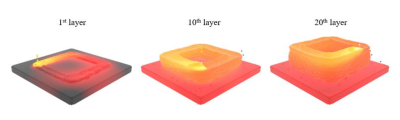
Within Additive Manufacturing (AM) technologies, Wire Arc Additive Manufacturing (WAAM) stands out as a particularly promising process variant. WAAM enables the efficient production of large metal structures and offers significant advantages over traditional processes, especially in the field of repair welding.
A key component for optimizing the WAAM process is simulation, particularly in relation to the concept of a virtual factory. A digital twin could significantly accelerate the wire-and-arc-based AM manufacturing process, especially regarding development, optimization, and certification.
Developing a precise simulation model is crucial to correctly map a weld's geometric shape. In the presented work, Smoothed Particle Hydrodynamics (SPH) is used to develop a model that simulates multiple weld beads building on each other – an area that is not yet fully established due to complex physical interactions and the enormous computing resources required.
The focus of the work is on heat and mass transfer during the WAAM process, aiming to create a model that calculates interactions within a geometry of numerous layer structures while significantly reducing calculation time. The proposed approach fully accounts for mass and heat transfer in the cathode area, while droplet formation and detachment are captured by an equivalent model for more efficient use of computing resources.
The concept for accelerated calculation incorporates a coarse mass discretization and the neglect of a direct resolution of the anode area. Accordingly, the model focuses on the processes in the cathode area concerningt the weld to be formed. A side effect of this concept are local deviations in the weld geometry arising from surface tension models in the SPH formalism, affecting global component geometry.
The potential of the model for predicting the temperature field could be demonstrated in the simulative reproduction of an eccentric pin as an industrial reference product. However, there is still no satisfactory agreement between the calculated geometry and the real component. While geometric agreement requires further calibration, the temperature field prediction shows strong consistency with the industrial process. Calculation time still holds potential for improvement.
This work makes a significant contribution to the further development of simulation methods in the field of WAAM and provides valuable information for improving process control and increasing efficiency.
@InProceedings{MWW+25,
author = {Mokrov, Oleg and Warkentin, Sergej and Westhofen, Lukas and Antonissen, Joachim and Bender, Jan Stephen and Sharma, Rahul and Reisgen, Uwe},
title = {{S}olution {A}pproaches for the {E}fficient {M}odelling of the {L}ayer {B}uild-{U}p in the {WAAM} {M}anufacturing},
booktitle = {[Mathematical Modelling of Weld Phenomena 14, 2025-09-21 - 2025-09-24, Graz, Austria]},
year = {2025},
pages = {301-312},
month = {Sep},
organization = {Mathematical Modelling of Weld Phenomena 14, Graz (Austria), 21 Sep 2025 - 24 Sep 2025},
publisher = {Verlag der Technischen Universität Graz},
date = {2025-09-21},
doi = {https://doi.org/10.3217/978-3-99161-089-2-014},
}
